
When discussing airport noise pollution, attention naturally focuses on takeoffs and landings. However, the noise does not stop once the aircraft is parked. During a layover,the Auxiliary Power Unit (APU) may continue to operate to provide the aircraft with electricity, air conditioning, or heating, and to enable the main engines to be started.Its noise impact differs from that of an airplane taking off: it is more localized and primarily affects the immediate vicinity of the gate, the crews working on the apron, and the passengers. Depending on the airport’s layout, the location of the parking areas, and the times they are in use, it can also contribute to the noise nuisance experienced by nearby residents.For airports, reducing this noise therefore means going beyond mere restrictions: it is necessary to understand when, where, and for how long APUs are actually operating.
Why do APUs contribute to noise pollution on the ground?
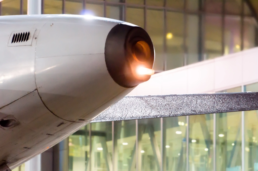
An APU is a small turbine, typically installed at the rear of the fuselage. When the main engines are shut down, it provides the power needed for several aircraft functions: electrical power, cabin air conditioning or heating, and engine start-up.Like any jet engine running on kerosene, its operation simultaneously generates noise and air emissions.
ACNUSA (the Airport Noise Control Authority) describes APUs as generally “very noisy” engines and emphasizes that the noise they generate particularly affects employees, passengers, and nearby residents. The French authority has also incorporated measures to reduce their use into its policy to combat noise and air pollution around major airports. However, this issue must be viewed within the broader context of airport noise. Takeoffs, landings, and other aircraft movements remain the primary contributors to noise exposure in these areas. According to the EASA (European Union Aviation Safety Agency), 3.4 million people living near 98 major European airports were exposed in 2023 to aircraft noise levels of at least 55 dB Lden. APU noise is therefore less of a large-scale acoustic problem than a source of nuisance that is particularly concentrated around ground operations. This distinction is essential for selecting the right courses of action.
Why is APU noise becoming an operational issue for airports?
Reducing the use of APUs has the unique advantage of simultaneously improving several aspects of airport performance.

Working Conditions on the Apron
The first presentations are from the teams working on the aircraft: handlers, baggage handlers, technical crews, catering staff, fueling crews, and agents performing turnaround operations. Schiphol Airport also considers reducing the use of APUs a priority for improving working conditions on the apron, explicitly citing noise as one of the nuisances caused by their operation.3 “The issue, therefore, is not merely about reducing an environmental indicator. It directly affects the day-to-day environment of the ground crews.”
Relations with Local Residents
The impact on surrounding communities depends heavily on the layout of each airport: the distance between the stands and residential areas, the orientation of the parking lot, noise barriers, operating hours, and the time of day. Nighttime operations are naturally more disruptive. At Nice Côte d'Azur Airport, for example, the environmental noise prevention plan explicitly identifies reducing APU operating time as a measure designed to lower aircraft noise on the ground for residents living closest to the airport.
Environmental Compliance
The reduction in APUs is also being gradually incorporated into operational rules. In France, several major airports now have specific restrictions on their operating hours. ACNUSA notes that these restrictions are intended to reduce both air pollution and noise pollution. At the European level, the AFIR Regulation (Regulation on Infrastructure for Alternative Fuels) is simultaneously accelerating the deployment of electrical power supply for parked aircraft. The French Ministry for Ecological Transition emphasizes that these alternative solutions generate less noise, greenhouse gases, and air pollutants than APUs.

Reducing APU Noise: Infrastructure Alone Is Not Enough
One of the most straightforward solutions is to replace the APU with ground-based equipment:
The AFIR requires that a power supply be made available for commercial aircraft parked at designated stops on the TEN-T (Trans-European Transport Network), thereby helping to reduce the use of APUs during ground operations. Heathrow Airport explicitly identifies APU restrictions and the use of FEGP and PCA as means of reducing ground noise. However, installing this equipment does not guarantee its use. A gate may be equipped with FEGPs and PCAs, yet the APU may continue to operate due to availability issues, a delayed connection, a malfunction, technical incompatibility, operational constraints, or simply insufficient adoption of the practice. The question to ask is therefore no longer simply: “Do our stands have an alternative to the APU?” but: “ When this alternative is available, is it actually being used, and does it reduce APU operation?” This marks a shift from a mindset focused on installed capacity to a focus on observed performance.
Why do traditional approaches provide only a partial view?
Acoustic monitoring networks, noise maps, and indicators such as Lden (Level Day Evening Night) or Lnight (Level Night) are essential for tracking overall noise exposure around an airport. The European framework also requires a structured assessment of noise and a balanced approach to noise management.
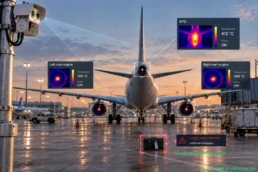
But these indicators primarily answer one question: What is the level of noise exposure? To take action on operations, a second question becomes necessary: Which operation or behavior is causing a preventable nuisance? Spot checks on the apron can verify certain practices but do not necessarily provide a comprehensive view of the thousands of flight operations carried out over the course of a year. The Waltr solution makes it possible to monitor and analyze behaviors that cause noise disturbances, such as the use of the APU, or the failure to follow the “N-1” engine procedure from landing to parking and through takeoff. Real-time alerts can be sent to ground crews. Waltr can also send reports with timestamps and identification of the affected aircraft as needed. To implement a noise reduction plan, the airport must be able to move from a one-time snapshot to an analysis that can be repeated over time.

How can we effectively reduce noise pollution caused by APUs?
An effective strategy relies on a combination of infrastructure, procedures, and measurement.Having alternative equipment to the APU helps reduce noise pollution when operational conditions permit.
The restrictions must then be translated into practices that are easy for airlines and ground handlers to implement. But the third lever is essential: measuring actual usage.An airport must be able to determine whether an APU is shut down promptly after arrival, when it is restarted before departure, and whether the observed times correspond to the defined procedures. When discrepancies arise, the goal is not merely to note a non-compliance. The cause must be identified. A long APU runtime at a gate where the PCA is regularly unavailable requires a different response than a long runtime when all infrastructure is available. In the first case, the priority may be maintenance or investment. In the second, it may involve procedures, coordination among stakeholders, or change management support for the teams involved.
What metrics should be monitored to reduce APU-related noise?
To move from an environmental goal to a measurable improvement, several KPIs can be tracked:
From APU Measurement to Improved Practices
It is precisely in this regard that operational data gains value. At Nice Côte d'Azur Airport, Waltr has been deploying its Aircraft Emission Tracker since May 2025 to automatically detect and time the use of APUs and main engines on the tarmac. In particular, the system tracks usage durations per flight and helps teams reduce avoidable use.

The benefit of noise management is indirect but tangible: the shorter the time an avoidable noise source is in operation, the shorter the time it contributes to the apron’s noise environment.This approach, therefore, does not involve directly measuring decibels. Instead, it provides additional data: the duration and location of the activity causing the noise disturbance. By combining this information with operational constraints and equipment availability, the airport can identify situations where action is actually feasible.The data also serves as a tool for dialogue between the airport, airlines, and ground handlers. Rather than relying on impressions or a few isolated observations, stakeholders have an objective basis for analyzing practices and measuring how they evolve.
Toward a More Integrated Approach to Ground-Level Noise Management
Airport noise pollution cannot be addressed through a single measure. The European framework is based on an approach that combines noise reduction at the source, operational procedures, land-use planning, and, when necessary, operating restrictions. Within this comprehensive framework, the APU represents a key lever: unlike certain noise sources inherent to aircraft movement, a portion of its on-ground operating time can be avoided when infrastructure and operational conditions permit. The gradual electrification of parking stands further reinforces this approach. The challenge for airports will therefore gradually shift from “having an alternative” to “demonstrating that this alternative is available, being used, and producing the expected improvement.”
APUs alone do not account for the entire problem of airport noise. However, their impact is particularly noticeable on the apron and can also contribute to the noise disturbances experienced by residents living near certain airports. There are three complementary measures:
Sources1 - ACNUSA: Restrictions on auxiliary power units (APUs). French framework regarding APU restrictions and noise and air pollution.2 - EASA: European Aviation Environmental Report 2025. European data on exposure to aircraft noise and environmental challenges at airports.3 - Schiphol – Action Plan to Reduce APU Use4 - Heathrow Airport: Ground Noise. Limiting APU use and utilizing FEGP/PCA to reduce ground noise.5 - Regulation (EU) No. 598/2014. European framework for a balanced approach to airport noise management.