
Across Europe, reducing the use of Auxiliary Power Units (APUs) has evolved from an environmental goal to an operational issue for airports. Fixed Electrical Ground Power (FEGP), Ground Power Units (GPUs), and Pre-Conditioned Air (PCA) are being deployed to reduce reliance on APUs during turnarounds, while local regulations specify when and for how long an APU may operate.However, there is an important distinction between having an APU restriction and being able to demonstrate how it is applied in daily operations.Under the Alternative Fuels Infrastructure Regulation (AFIR, Regulation (EU) 2023/1804), European airports on the TEN-T core and comprehensive networks must provide electricity to stationary aircraft at all gates starting in January 2025 and at all remote stands starting in January 2030.However, there is no single European maximum APU runtime. Actual restrictions are still largely determined by airports and local authorities.For airport operators, the challenge is therefore to shift from rules to evidence: understanding what actually happens on a flight-by-flight, gate-by-gate, and turnaround-by-turnaround basis, as Nice Côte d’Azur Airport Use Case.
APU restrictions in Europe: a largely local framework
APU restrictions vary significantly among European airports.
Amsterdam Schiphol
APUs may normally operate for a maximum of five minutes after arrival and five or ten minutes before departure, depending on aircraft type. Exceptions may apply under specific operational conditions.
London Heathrow
FEGP and PCA are considered primary energy sources, while the APU is treated primarily as a contingency solution. For most aircraft, APUs must be shut down within ten minutes of arrival, while departure allowances vary depending on aircraft category and operational conditions.
Marseille Provence, France
In France, local ordinances establish APU restrictions for major airports. At Marseille Provence Airport, when alternatives for electricity, heating, or cooling are available, APU use is limited to ten minutes before scheduled departure and ten minutes after arrival. The airport operator must also provide authorities with available information that helps assess actual APU runtime and the use of alternative equipment.

Why APU restrictions are becoming a strategic operational issue
The first step in an APU reduction strategy is straightforward: define restrictions and provide alternative ground infrastructure. The second stage is more difficult. An airport needs to determine whether external power is actually available when needed, whether crews and handlers use it, whether the APU is turned off accordingly and, when this does not happen, why. A stand can theoretically provide FEGP or PCA while an aircraft continues to operate its APU due to equipment failure, delayed connection, cabin-conditioning requirements, aircraft-specific procedures, or coordination issues during turnaround. This changes the management issue. It is no longer simply: “Are our booths equipped?” It becomes: “When the infrastructure was available, was it actually used, and did it result in the expected operational behavior?” Installed capacity and operational use are two different KPIs.
A common issue faced by airports, airlines, and ground handlers
APU reduction cannot be effectively managed by a single stakeholder alone. For the airport operator, the challenge is to align infrastructure availability with actual aircraft behavior. A low compliance rate may indicate insufficient infrastructure, poor equipment reliability, or limited adoption. For airlines, reducing unnecessary APU runtime can support fuel efficiency and environmental goals, but operational and safety requirements remain paramount. Reliable data should therefore distinguish between avoidable runtime and legitimate exceptions. For ground handlers, the timing and availability of equipment connections are critical. Delays in connecting the GPU, FEGP, or PCA can directly extend APU runtime. This makes APU performance a shared turnaround KPI rather than simply an environmental indicator.
Why Traditional Compliance Monitoring Has Limitations
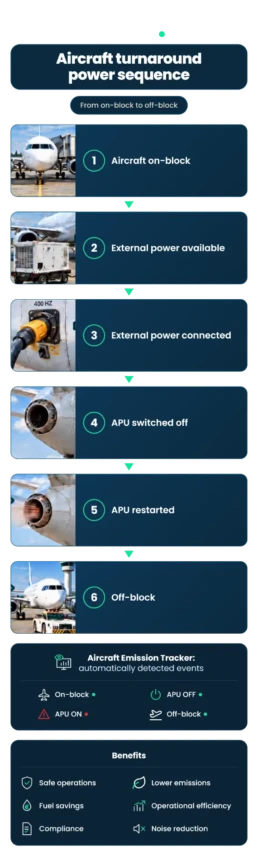
An airport operating instruction defines what should happen. It does not automatically show what happened. Manual airside audits remain useful, but they only capture the operations observed during a specific period. Similarly, emissions inventories and modeling tools can estimate APU-related emissions but do not necessarily determine the exact behavior of individual aircraft during each turnaround. For operational performance management, airports increasingly need more detailed data. Ideally, the turnaround timeline should make it possible to identify: Aircraft on the block → external power available → external power connected → APU turned off → APU restarted → off the block This sequence can then be contextualized using information such as:
From infrastructure to operational evidence
As ground-power infrastructure becomes more widespread across European airports, the strategic focus will increasingly shift from availability to utilization. This is where APU monitoring can evolve from an environmental reporting exercise into an operational management tool. At Nice Côte d’Azur Airport, Waltr’s Aircraft Emission Tracker detects and measures APU and main-engine use at aircraft stands. The approach combines systematic observation with reporting and change-management support to help airport teams understand operational practices and measure progress.


For European airports, the next step is therefore not simply to introduce stricter rules. It is to gather the operational data needed to determine whether those rules are bringing about measurable change. Want to understand how APU use can be measured across your airport operations?
SourcesEuropean Commission – Alternative Fuels Infrastructure Regulation Q&A. Specifically, the guidance in Article 12 on electricity supply to stationary aircraft and the Commission’s clarification that the AFIR does not prohibit APU operation.European Commission AFIR Q&ARegulation (EU) 2023/1804 – Alternative Fuels Infrastructure Regulation. Article 12 establishes electricity supply requirements for stationary aircraft at TEN-T airports.Regulation (EU) 2023/1804 on EUR-LexICAO – Airport Air Quality Manual, Doc 9889. Guidance on APU restrictions, alternative ground power sources, and the need to consider operational and safety interdependencies.ICAO Airport Air Quality ManualAmsterdam Airport Schiphol – Minimizing APU Use. Current APU limits, exemptions, monitoring, and enforcement framework.Schiphol APU RulesHeathrow Airport – Operational Safety Instruction: Use of Aircraft Auxiliary Power Units. Rules on FEGP/PCA priority, permissible APU operating times, exemptions, and monitoring.Heathrow APU Operational Safety InstructionFrench Government – APU restrictions at Marseille Provence Airport. Local operating limits, mandatory use of alternative equipment, and reporting requirements regarding actual APU and alternative-equipment use.French APU regulations on LégifranceEUROCONTROL – Open-ALAQS. Airport-specific air-quality modeling covering sources including aircraft APUs and GPUs.EUROCONTROL Open-ALAQS